Saturday, 7 June 2014

Planning Ahead


We have not had a world best lambing time. More barren ewes than I would like for one thing, but on the positive side we have had some cracking lambs. The time has come though to control more of the lambing cycle. For starters we need to buy our own tup.

Last time around we borrowed a rare Whiteface Woodland tup and he did a great job. He was not available this year, having been sold off to a farm in Cumbria. We did try for a similar lad, but unfortunately we could not arrange it. Plan B was to use a neighbours Texel ram. The ease of lambing was a very pleasant surprise. I only had to help on one occasion, and that was post birth, helping the lamb connect for a drink.

I think we have hit upon a system! 


Chatting with Ruth Dalton of the Rare Breed Survival Trust (RBST) she asked that I note the growth of the lambs. So, I weighed each lamb three days after birth, at the same time as clipping on their identity tags and docking their tails. I will weigh them another two times and note their weight gain. Ruth suggested the weighing project as a potential means to remove the Whitefaced Woodalnd from the RBST watchlist. If the ewes demonstrate their capability as milky mothers other farmers may include them in their flock. Let’s see how we go…

Clearly an essential element of this system is a Texel tup. That means looking out for the right animal at the sales prior to the lambing cycle beginning again later this year.

On a slightly different note, I will visit the Malton Food Festival over the bank holiday weekend. My main aim is to look at any concepts farmers are using to attempt to reach audiences with their products. That usually means burger vans or similar. But beyond that I want to look at packaging. I am unsure about our own stall at the present, the north just doesn’t have the markets to make the expense e.g. travelling etc worthwhile. But I do want to try a direct sale/mail order approach. At the same time there is bound to be a tasty sausage, or two, to be had.

I plan to kill three pigs for direct sale this month. They will be available on a first come first served basis so please do get in touch if you enjoy pork. I have already sold one quarter to a dairy farmer in Scotland. That should prove an excellent test, both in terms of feedback regarding our meat but also the wool packaging I intend to use. 


Originally written for and published in the Esk Valley News, June 2014 issue.

http://www.eskvalleynews.co.uk/

Sunday, 4 May 2014

Live Stock, Dead Stock


It is one of the harsh realities of farming that, as an old saying goes, ‘when you have livestock, you will have dead stock’. Having said that I will never take it with a casual mind when an animal dies. Obviously we breed stock to kill, but until then they have a right to the best quality of life possible.

This month I lost a pedigree rare ewe. She was up and about at 8am, then down at 12 o’clock. I half suspected a nutritional deficiency, but her body condition was good. Becky from Gracelane Vets came for a look, suspecting Twin Lamb disease. The ewe was trying to eat which is always a good sign, but she was blind. This pointed toward poor nutrition conversion again.

It is always reassuring to watch a professional at work; Becky prepared the drugs she would administer, and then quickly shaved a small portion of fleece away from the neck. All three fluids where then injected into the vein of the sheep. It would be nice if the animal jumped up and was immediately cured, however she was moved by Landrover to an outbuilding to rest. I especially dislike that, when we keep our stock outside year round.

I was left with a special drench (oral medicine) that had to be administered daily. But administered how? ‘An old wine bottle is best because of the smooth lip’ Becky said. This could be tricky… The recycle collection had been that week. The only other bottle was in the fridge. Oh well, Nicola always says the health of the stock comes first.

The medicine bottle was promptly cleaned and the drugs heartily swallowed. Another good sign. Twin Lamb disease does as the name suggests apply to pregnant ewes, but they are not carrying twins as a rule. A big single lamb can have the same effect if the sheep isn’t eating well enough. In this case I was blindsided as the mild weather has helped the sheep, with the grass growing underneath them. The flock has access to minerals and hay but the vet confirmed her initial diagnosis. All the more galling really as they were a day away from starting on oats, part of their pre-lambing diet. After giving two drenches the ewe died a couple of days later. 


The big take away for me is to be better informed. So, more soil and grass tests to make sure the goodness that looks to be in the grass is there. Plus, I will conduct more regular condition scoring and weight checking too.

On a lighter note both of our pregnant sows farrowed. The picture shows a group of Saddleback’s from a litter of 11. 


Originally written for and published in the Esk Valley News, May 2014 issue.

http://www.eskvalleynews.co.uk/

Friday, 11 April 2014

Pink Lady


In March I had great fun helping the tourism team at the National Park with advanced promotion of their Lost Sheep in Pink Jerseys campaign. Asked if it was possible to create a live pink jersey sheep I quickly said yes. That said, I could not remember BATA stocking a pink spray!

The solution was a hairspray from Superdrug’s on-line shop. It took a few cans but we got enough spray on to one of our Whitefaced Woodland girls. The can states that it washes out in the shower… Well, the rain will need to do that job as I have no intention of shampooing a ewe!

Residents, businesses and organisations across the North York Moors can register now and display a sheep in a pink jersey between 20 June and 20 September.


Visitors will be asked to spot at least three lost sheep around the North York Moors and coastal area, enter the details online with a chance to win a large selection of prizes. They'll be able to enter as many times as they like, so there's an incentive to spot the sheep in different places.

All of the details can be found on the Park website: northyorkmoorstourism.com. We certainly did something right, the pink sheep and I made the front page of the Yorkshire Post!

Last month I wrote about soil, grass and the part they play in the success of the farm. One key element of pasture health is drainage.

We have already spent a great deal of time and effort installing and repairing drains. I have always admired the effort that prior generations invested in their construction. To walk out of the house every day to dig, by hand, a metre under the surface, over 400 metres to move water away is an awe inspiring achievement. Even to mend a broken drain leaves me with a sense of a job well done, perhaps not immediately but over the following days and weeks as a field dries. Of course it is more than likely that a mini-digger is involved nowadays.

The picture shows a clay pot pipe drain that was found and exposed to clear a blockage. The water is now flowing and this summer the same dry grass area will contribute to a better hay crop.

Lambing Live is back on television. Lambs are due here in early May so, attending various veterinary workshops I have been refreshing my knowledge of the techniques/drugs that are available. The evenings are a good opportunity to talk through challenges; a key discussion point being whether to dip or spray iodine on the navel of the new born lambs. Which will be more effective at controlling infection..?


Originally written for and published in the Esk Valley News, April 2014 issue.

http://www.eskvalleynews.co.uk/

Sunday, 9 March 2014

Is that Grass Growing Yet?


Despite the wind and rain it feels mild. I cannot help but think that the grass should be growing it looks so green in some fields, but a quick look at the gauge on our soil thermometer soon dampens my anticipation. Regrettably the warmth I feel while working outside has not transmitted down to the earth and I have not seen anything close to the six or seven degrees centigrade required for the grass to grow.

Thankfully that bit of snow we had came and went rapidly without causing any livestock or travel challenges. Sledging opportunities were likely to have been limited for the kids mind you…

Kirsty Brown from the National Park signed off the rebuilt 130 metres of dry stone wall, so the next project is… well, to build a dry stone wall. This is a shorter length, with a new drain underneath it. The drain is essential to prevent water running off the top of the pasture, eroding the soil as it goes.

It is funny how quickly I have come to realise how essential the soil is to any form of farming. I long since stopped thinking that I produce lamb. Now I know that I have to maintain the best soil health possible so I can in turn produce nutritious grass. I am a grass farmer, simple. After that, it is down to the choice of animal/breed that can survive the conditions.

Which leads me nicely into moles… They have been busy wrecking pasture more so than I have seen before. So I have begun the annual game of controlling the monsters before they multiply. I avoid placing the traps in fields where the sheep are grazing. When the traps stop catching typical farmer cynicism tells me the moles are hiding under the ewes feet!


Our farm system (for the sheep at least) is grass based. So the plan is for the ewes to stay out all year, rotating through fields with a good cover of grass and low parasite burden. Clearly in winter that becomes a challenge. The solution is All Grass Wintering, a recognised technique using electric fences to keep stock from roaming at will (and eating
the best bits just like people would), controlling the rate the crop is eaten. We mix the grass with stored forage (hay) provided in metal racks and hope to successfully manage each animals’ body condition through to lambing in May. Clearly, when the girls are eating for two (or three) they need a balanced diet that meets their energy needs. How effective our system is here on the Moors comes right back around to choice of breed. Our native Whitefaced Woodland’s have a reputation for thriving on poor ground. That said, I will be happy when the grass starts to grow again.

Originally written for and published in the Esk Valley News, March 2014 issue.

http://www.eskvalleynews.co.uk/

Sunday, 2 February 2014

No Snow is Good Snow


Snow is certainly at the forefront of many minds. ‘No snow up there yet’, they say, even the neighbours are at, ‘when will it snow’ they ask. Right now I’m happy without it and hopefully by the time you read this we will still be looking at green fields. ‘It could still snow in April you know’, arggh, no, maybe this year we will have a snow free year?

Without the white stuff I have been able to get on and renovate a 130 metre stretch of dry stone wall. The first task involved finding a lot of the top stones in the verge. That meant cutting back the dense thicket of bramble and nettle that has secured a foothold over the years. In my mind that is a job worth doing as weeds in the verge easily become seeds in the fields, which in turn require removal the next summer and beyond. Have you read the saying ‘one years seeding, seven years weeding’? It applies to nettles so it is well worth removing them.

A few years back I found an old National Park paper that listed the roadside verge in our part of Farndale as being of interest due to the abundance of wild flowers. Sadly there is not much to see, but we have seen on some stretches that keeping the dominant weeds species cut back does allow more delicate plants a chance to grow. To my mind it is a good think having a verge swap wild flower seeds with the field, rather than the nettles and thistles that the stock won’t eat and require labourious methods of control. One theory I have read relating to the strong growth of nettles etc in the verges suggests they enjoy the road salt we put down to melt the ice and… and we are back there again!

In a different part of the farm, but still on the topic of invasive plants, our pigs have done a wonderful job of clearing away a stretch of bracken. It is great to see them getting down into the root system. It is surprising to see the volume and strength of the roots as they lie exposed, but the girls make short work of it. They are often to be seen crunching chunks of it, with the ends poking out of the sides of their mouths.

British Saddleback pigs are renowned for being hardy. It is one of the reasons we chose the breed to help us tidy the farm up. It is still a surprise to see them ignore their ark in favour for a nest. On the other hand it is wonderful to see them exhibit their natural behaviour, sleeping out together in a carefully built rush bed. I wonder if they will carry on doing that when the you know what comes…


Originally written for and published in the Esk Valley News, February 2014 issue.


Monday, 16 December 2013

Our Meat, Our Customers


It has been thoroughly enjoyable delivering our pork to our customers this past week. It is such a pleasure to be able to see the regard they have for local produce, it makes the effort worthwhile. I certainly would not have received the type of feedback I was offered had I simply sold the pigs in a market.

Even better, it is wonderful when you hear people talk of their experience eating our pork. This is the type of dialogue I hope I can develop while improving my stock rearing and meat marketing skills. In addition I am keen to understand the best form of packaging and presentation should we decide to send the pork further afield. One especially attractive solution utilises British wool, wrapped in plastic, together with ice to keep the meat cool.

I spent my first visit to the Fox and Hounds in Ainthorpe listening to Ian Cairns of SAC Consulting discuss rush management. Rushes thrive on poor, wet soils therefore they are well suited to the Moors!

That suitability means they can quickly overtake the more valuable pasture grasses and once established they are difficult to remove. Cattle and sheep can’t help, rushes are bitter and are left behind unless stock are left with nothing else to eat. I was told what I thought was an old wives tale, that cutting the rushes seven times a year would hamper their growth. As it turns out the consultants believe that six times is enough!

We have drained some of our soils, but that action alone has not reduced rush growth. It will however, especially as the weather has been so dry, allow some cutting before the end of the year.

The sheep breeding cycle began again this week when the tup was introduced to the flock. I plan to lamb outside so hopefully the weather will be kind when our new borns are due in May next year.

On a sad note it was Steve Wilson of Cote Hill’s funeral back on the 11th December. I had seen Steve to wave to many times. On the one occasion we did spend longer talking I caused trouble for his dad! I was supposed to be helping two of our older neighbours and Dennis, Steve’s dad, load the Farndale Show tent into a trailer. Instead Dennis pointed me toward the milking parlour and I was off like a shot! It was great to see Steve working with the cows, it is a wonder to watch them hop up and wait for the clusters to be attached. Outside there was a good deal of mumbling aimed toward Dennis as the senior squad performed the heavy lifting. RIP Steve.


Originally written and published in the Esk Valley News, January 2014 issue.

Saturday, 7 December 2013

Why'd That Sheep Die?

'Do you want to come to a sheep autopsy'?

It's not a question I get asked everyday. But sheep do have a reputation for dying for no reason whatsoever. That's not a view I subscribe to, there's obviously a reason behind every loss, so learning more is important for the health of our flock.

Post Mortem Evidence Collection as an Aid to Veterinary Diagnosis of Sheep Diseases. That was the snappy title given to the six hour course run by a veterinary surgeon. We began with a powerpoint presentation that set out the basics of sheep anatomy and why an autopsy performed on farm is worthwhile.

Farmers look at their stock everyday, and you can notice characteristics and behaviours that point toward ill health. We were advised to consider the following list:

1. Weight loss
2. Respiratory signs
3. Scour (farm/vet language for diarrhoea)
4. Abortion
5. Neurological
6. Skin / Wool
7. Lameness
8. Sudden death!

Clearly the latter sign would tell you something is definitely wrong! But what..? In the lead up to death had the animal displayed any of the other signs? Observation at every stage is important, but eventually the only way to really tell what happened is to look inside. In all cases the autopsy had to be conducted within 24 hours of death.

Allowing farmers to conduct their own investigations isn't as precise as the service offered by the Veterinary Laboratories Agency (the VLA - our nearest is in Thirsk), but it does offer an instant answer for diseases with specific pathology e.g. fluke (see: http://en.wikipedia.org/wiki/Trematoda). That rapid determination then allows for wider flock treatment decisions.

As well as speed another consideration is cost, a VLA examination is £160 including carcass disposal. Clearly a matter requiring some thought balanced against the risk of potentially not discovering the cause of death. In my case I could see myself examining one or two sheep to find the cause of death but if I failed I would be looking toward our vet and the VLA for professional help, especially if losses were mounting.

We were given a full round up of the kit required, including the sense behind vets wearing a pair of long gloves and another short pair over the top for better feel. The last item on the list was a digital camera.

These pictures are not taken to shock, but rather as an important personal aide memoire. In addition as clearly as I could describe the colour of specific internal organs that information can provide clues to aid diagnosis.

First things first, a quick check of the teeth. This ewe was six years old, so it would be normal for her to be missing teeth. The teeth you can't easily see (the mouth can't be opened wide enough) are the molars. In bad condition the sheep would not be able to cud. In this case she appeared to be ok for her age.

The next task was to cut the skin and fleece away with a sharp knife. In doing so we were reminded to only use sharp tools and not to get carried away, our instructor could relate stories involving friends that had suffered injury as a result of being over eager with a blade.

This picture shows the wind pipe. As well as not cutting ourselves we were also told to be careful to avoid damage to the organs and the potential for contamination of any samples.


Here the animal has been opened up to expose the gut. This was removed and laid out for examination. At this point it was emphasised that touch is crucial. Are the organs hard/soft? For anyone reading that has gutted a rabbit before, the principal of the sheep's gut is the same, albeit on a larger scale. 


One of two healthy looking kidneys, see below.


On closer examination one of the kidneys was marked (above the thumb on the lower hand), but not in such a way as to indicate that this was the cause of death.


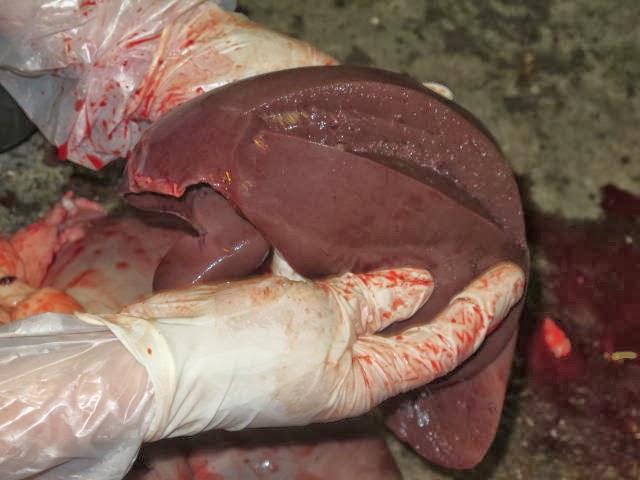
The liver; this was a major concern prior to the procedure. It actually turned out to be healthy. The fluke worms that can be a risk in wet periods can severely damage the liver, adults worms leaving biro diameter tunnels through the structure.

It is amazing to note however that the sheep can survive with up to 70% liver damage and recover after treatment.


A section through the liver demonstrating its condition. 


Where the problem lay. The sheep had been suffering from breathing difficulties and in its last days had been struggling to keep up with the flock. Here the diaphragm has been removed and the lungs revealed.

In a healthy animal the lungs would be a fluffy pink colour. Here they are clearly not and are burdened with white'ish tumors. Clearly we had identified the problem; the vet diagnosed Maedi Visna (MV).

Sheep farmers will be familiar with the disease. If you are a regular visitor to agricultural shows over the summer months you may have noticed that sheep are often split into groups, one MV accredited and the other not. MV travels through the air and the sheep are separated to avoid the risk of the disease being transmitted.

A number of this flock are now having their blood tested to check for MV. It may be that this sheep was the only victim. Certainly without the autopsy the illness would not have been identified and the rest of the flock left at risk.


Wednesday, 27 November 2013

Longer Nights


If I lived indoors all day without a clock I would still know the clocks had changed and the days had become shorter as the number of meetings in my calendar grows. These meetings are not to sniffed at though, and two in particular have been especially interesting.

The results of the reform of the Common Agricultural Policy will be at the forefront of all farmers minds. The NFU held a briefing in Kirkby to outline how the new regime is coming together. After years of EU deliberation DEFRA is consulting farmers and a host of interests with differing expectations. The NFU certainly has a different view to The National Trust, or to a host of green lobbying groups. As matters stand today it appears that hill farms will benefit from the new deal, with the settlement providing equal payments per hectare for lowland farmers and their colleagues in the uplands. Previously the split benefited the lowlands. That is good news! However the picture is vague for grass based businesses. Arable farmers know they will be subject to a number of new ‘greening’ measures, but so far there is a vacuum for grass farms. It is certain that the Entry Level Stewardship scheme is no more, but what replaces it and how much funding (modulation) will it draw from the main subsidy pot? It is all up in the air.

The Sun Inn, Bilsdale, was the venue for a North York Moors Quality Sheep Association meeting. The group encourages Moors sheep farmers to get together and discuss stock sales and other matters. A hot topic at this session was the introduction of Electronic Identification for sheep. A government led IT project, the idea is sound in principle however the technology fails to log all sheep passing a computer device. Farmers are principally upset as the failure to record sheep properly rests with us and can result in being fined by government!

Back on the farm I am continuing to monitor the pigs versus bracken project closely. I am really happy with progress to date, the girls are healthy and they are clearing the land excellently. In fact they have cleared enough bracken to offer views I have not taken in before.

Winter finally arrived this week. The drop in temperature is noticeable; I have even broken out my woolly hat! Of course the sheep just carry on regardless. But the hay racks are in place and as the grass loses its protein value our stored forage will come into play. We had a good summer, so will we pay for it? We will wait and see.

Wednesday, 6 November 2013

Hashtag Mob


Helping communities to understand the benefits of social media was one of the topics of the first National Park Community Forum in Pickering. It was fun to speak in the school hall at Lady Lumley’s. My twitter account has helped me to ask more knowledgeable folk questions about a range of farming topics. If you were to look as I write I have been lucky enough to exchange comments regarding high stock density or ‘mob grazing’ techniques.

Parish councilor David Hugill was at the Forum; luckily for me he was wearing his #clubhectare jacket. #clubhectare is a farming group set up to share business concerns, solutions and a bit of gossip. To group their conversations together people use a name or hashtag. The National Park has its own hashtag: #northyorkmoors.

Everyone likes a nice surprise every now and then. Being able to use a mobile phone, even for emergencies, on the Moors would be welcome. So it was a surprise when the ‘Park announced that 18 phone masts could appear before March 2015. If you really want to press the importance of having improved mobile phone coverage you should write to your local councilor or MP. Anne McIntosh replied to my correspondence this week and has passed on my supportive views to the Secretary of State for Culture, Media and Sport, Maria Miller.
 
Our neighbour Ken’s pedigree Charolais bull had been lodging with us for a fortnight. He had been getting a little impatient with some of his maturing male offspring, so we kept him and a small harem out of trouble until the calves were sorted for Farndale’s suckler sale. The picture shows him making his way home. The two walkers he and I encountered by the Chapel were impressed by the old boy!
 
The other picture shows Curly (anyone guess why she’s called that?) one of our older Whitefaced Woodland ewes enjoying the rare sunshine. Fluke, a worm that can infect the liver of sheep and cattle, can be prevalent in wet periods so we are keeping a close eye on the girls. The newspapers are now suggesting November will be very wet; surely that can’t be true!

Producing food for public consumption is obviously the core of what farmers do. Recently it has been satisfying to take rare breed, free range pigs through to a local butcher and receive good feed back from him. My main aim however is to sell the majority of our meat direct to our own customers. We are finishing pigs for pork and bacon now and want to develop that relationship. This winter we need to work hard on our box scheme, including the labeling that will show just where the meat came from, and from which animal. Saddleback ham for Christmas anyone..?

Originally written and published in the Esk Valley News, November 2013 issue.

http://www.eskvalleynews.co.uk/

Wednesday, 16 October 2013

Getting Stuck In


Originally published in Esk Valley News


http://www.eskvalleynews.co.uk/

Have you thought of having a go at keeping livestock? When I was asked to write these articles they were intended to share our experience of starting a farm from scratch. Then last month I had pictures of big machines at work, just a bit off topic!

If you are interested in producing a small amount of food for the table you will find chickens and/or pigs can provide a good start. You will be able to taste the difference!

To start with think through how your stock will fit in to your life. Can you provide adequate time, space and housing for them? What happens if you go away on business or on holiday? Chickens can absorb more time than you may imagine, but do not have the administration associated with bigger beasts (more than 50 birds, the rules change and you are a chicken farmer).

Fancy keeping pigs? You know they grow to be big, and noisy? And you know that you would need a County Parish Holding Number, plus a herd number? Do you have a large enough area and suitable shelter? The DEFRA website was updated recently and information for pig keepers is much improved.

We bought three recently weaned gilts (young females) to start with. The plan was to grow them while they tackled the weeds in some of our field corners, and eventually kill one for the freezer. Choosing which to take was easy as Number Nine began to bully the other two and reached bacon weight first. 12 and 13 (their ear tag numbers) have thrived since and had their first litters in February this year. Now ten boars are ready to be sent to Glaves at Brompton to be transformed into tasty pork pies, while we keep the gilts on and prepare them for the meat boxes we plan to sell direct to customers.

Choosing a breed of animal is an important step. All animals respond to how they are treated, but some will be more prone to be frisky than others. Tamworth pigs certainly have a reputation, and are perhaps best left until you have more experience and good fences! I would recommend looking into rare breed stock. Keeping a rare, registered, animal is a good way to prevent extinction of the less commercial breeds and you will probably be buying from a fellow smallholder. The Rare Breed Survival Trust website (www.rbst.org.uk) is a good place to start looking before moving on to the various breed societies.

So, think, have I got the room in my life, have I got the physical space, can I manage the documentation and will I be able to afford it (pigs need feed from BATA  etc)?

I would be happy to answer questions (if I can!) about starting with pigs. Please send an email to: petermawson@highfarndale.co.uk

It's Actually Summer!


Originally published in Esk Valley News

http://www.eskvalleynews.co.uk/

It is wonderful working in a t-shirt from first to last thing. I do keep asking myself how long the dry spell will last and how many jobs it is possible to tick off the list while it lasts.

I have been working on raised vegetable beds: the wooden frames are built and now I am filling them up with top soil. Our (rather large) heap of soil came from the back of the house as we dug down to remove the earth off the exterior walls. There are plenty of surprises therein including cutlery, broken glass and pottery, scrap metal as well as the ubiquitous bale band.

Nicola and I were lucky enough to be asked to help out the Rare Breed Survival Trust (RBST) at the Great Yorkshire Show. This comprised, mostly, of preventing enthusiastic children from getting too close to a Gloucester cow and her calf and talking with potential members. It also resulted in quite the coincidental meeting. A lady approached me to enquire about rare pigs, describing a situation in the 1970’s when she worked on a farm in Glaisdale. It quickly became apparent Sue was referring to Giles and Mary at Bank House. I still have their book at my bedside; that night I flicked forwards through the pages to find a story about the bolting horse and a noisy brush harrow!

In the afternoon at the Great Yorkshire we had chance to look around. It was great to see people we’ve bought stock from doing well with top prizes in both the cattle and sheep classes. In particular, Dave and Debbie Wardell from Pickering always have a fine Whitefaced Woodland tup on show. We have been mulling over which breed of cattle to concentrate on for some time now. The Belted Galloway regularly tops our wish list, so it was useful to talk with the Breed Secretary, Ian Sutherland, and meet some of the breeders and their cows. It is absolutely vital for us that the breed we choose can live out year round, thrive on our upland grass and mother healthy calves. In that respect we also took in the views of the Angus representative, but Belties remain favourite.

Just as I apply the finishing touches to this article Strickland’s of Hutton le Hole have arrived to rake and bale 11 acres of traditional hay meadow. The grass was cut on Wednesday and has been left to dry, in part so it reaches the correct moisture level for hay, but that delay allows some seed to drop off and enhance the sward. The job involves a lot of large machines driving through 12 foot gates with stone posts so time for me to run out and have a look…

You Had To Have Vision


Originally published in Esk Valley News

http://www.eskvalleynews.co.uk/


We liked the idea of buying a house/farm in the country, shifting our focus from London after living and working there for 29 years between us. Finding the right place is a challenge; prices in the south are ridiculous and the threat of a new railway or road being built close by is real. As a kid from Stockton I had been on many trips around the North York Moors, whether it was across the A171 to Whitby or looking for sticklebacks at Sheeps Wash. Later on I spent many happy days out walking, achieving Duke of Edinburgh awards with friends.

We did consider properties in the Dales and higher in Northumberland. But buying a house on the Moors, with its warmer sandstone buildings, proximity to the coast and transport links won through. We still had to find the right place of course...

At one viewing we engaged a surveyor to help with a valuation. We moved on but a couple of months later the same surveyor called me with the details of a farm we ‘would either love or hate'. Step forward nearly three years and hopefully the house restoration is sympathetic to the original and the land is clear and month by month better organised for livestock.

Before we signed on the dotted line I was well aware that hill farming was not a path paved with gold. In fact the surveyor who prepared our valuation said in disbelief ‘you don’t want to be a hill farmer do you?’ The answer in my head was ‘not solely, no’, but that knowledge of the industry still makes the conditions people consider to be normal eye opening. Instead of describing the state of the house it is probably best to say that we now enjoy central heating, clean water and damp free living. I will add that I do not miss living in the caravan we used during the renovation, although it had a shower, which was a step up on the house!

At the end of the transaction, many phone calls and a meeting in a pub car park more akin to a Bond movie we secured 42 acres, the house and a mix of sheds/outbuildings. The parcel of land varies in quality (it is all grade 3) from the traditional hay meadows by the River Dove to the acidic soils by the moor wall. We quickly fenced the area immediately around the house and yard and arranged with a neighbour to allow access for his cattle to graze the lengthening show of summer grass. That was the start of a relationship with John that endures to this day, based on a great deal of back scratching and a healthy amount of banter.

I recall one sunny afternoon standing with John taking in our view of the dale. I asked him to tell me again who lived in which house, who farmed where and so on. He happily started to point out the family farms and then reached a small cottage across the valley ‘don’t know them, they’re incomers!” Smiling, I turned to him and said ‘what, like us?’ He looked at me and slowly realised I was pulling his leg. Hopefully, as we’ve mucked in to help, worked hard on ‘the spot’ we have eroded the incomer tag a little. It is transparent to me that country folk that visit the dale from further field still regard us as incomers. I always wait for the reaction when I answer the inevitable question ‘where did you come from’ and I say ‘London’. If I had a softer skin I might take it to heart, but I also know that I was born further north and am thereby more northern!

We finally got around to buying our own sheep in September 2012 having taken the time to understand which breed would fit our circumstances and deliver the best value. We eventually chose a rare breed. There was a degree of cynicism with the mention of rare breed, but we were sure that we needed an element of uniqueness to offset our small scale. Now we are often asked why the Whitefaced Woodland is rare; it is big, hardy, milky and has textile quality wool. Our first lambing proved to be difficult with some of the shearling flock not taking to motherhood. I am told that professionals have struggled with first time mothers this year too. But, we have fostered lambs on and learned a great many lessons, taking advice where it was offered so we will be better placed to do it all again next year.

Sunday, 27 January 2013

New Pig Preparation

The day is fast approaching. Both of our Saddleback gilts were served by Carl the boar back in November. After three months, three weeks and three days we should be proud parents!

So, what exactly do we need to do? I thought it best to prepare a timeline leading up to and after the piglets arriving. I read Tony York's 'Get Started in Pig Keeping' book some time ago. As Tony has set matters out in a straightforward fashion I decided to dig his work out and review it.

One essential point that Tony and our two of our neighbours have stressed is that we leave each pig to farrow, 'it'll know what to do'. There is a risk that piglets could be squashed by their mother however so we need to prepare for that.

Preparation Jobs:
  1. Separate the gilts two weeks before (so they can come outside and see each other)
  2. Two weeks before the stomach and mammary glands will increase in size
  3. Buy a wormer from vet
  4. Buy iron sulphate paste from vet
  5. Create farrowing areas (refuges for the piglets to stay clear of their mum)
  6. Source a creep feed for piglets
  7. Rig up infra red heat lamps in each sty
  8. Clean the farrowing areas
  9. One week before apply a worming treatment
  10. Just before farrowing disinfectant the udders
  11. Look out for restlessness, even escape attempts - is the area secure?
  12. The day before, provide straw for each gilt to build a nest
  13. Be prepared to shut the gilts inside
  14. Three days before (or closer) the gilts release milk. Gently squeeze their teats to check
  15. Check the shape/redness of the vulva; the larger and redder the closer the piglets are
  16. Rub iron sulphate on the gilts teats every other day for the piglets to ingest.
Outstanding tasks:
  1. Need to identify the best creep feed
  2. Find water troughs for piglets
  3. Inform vet that the pigs are in pig!